
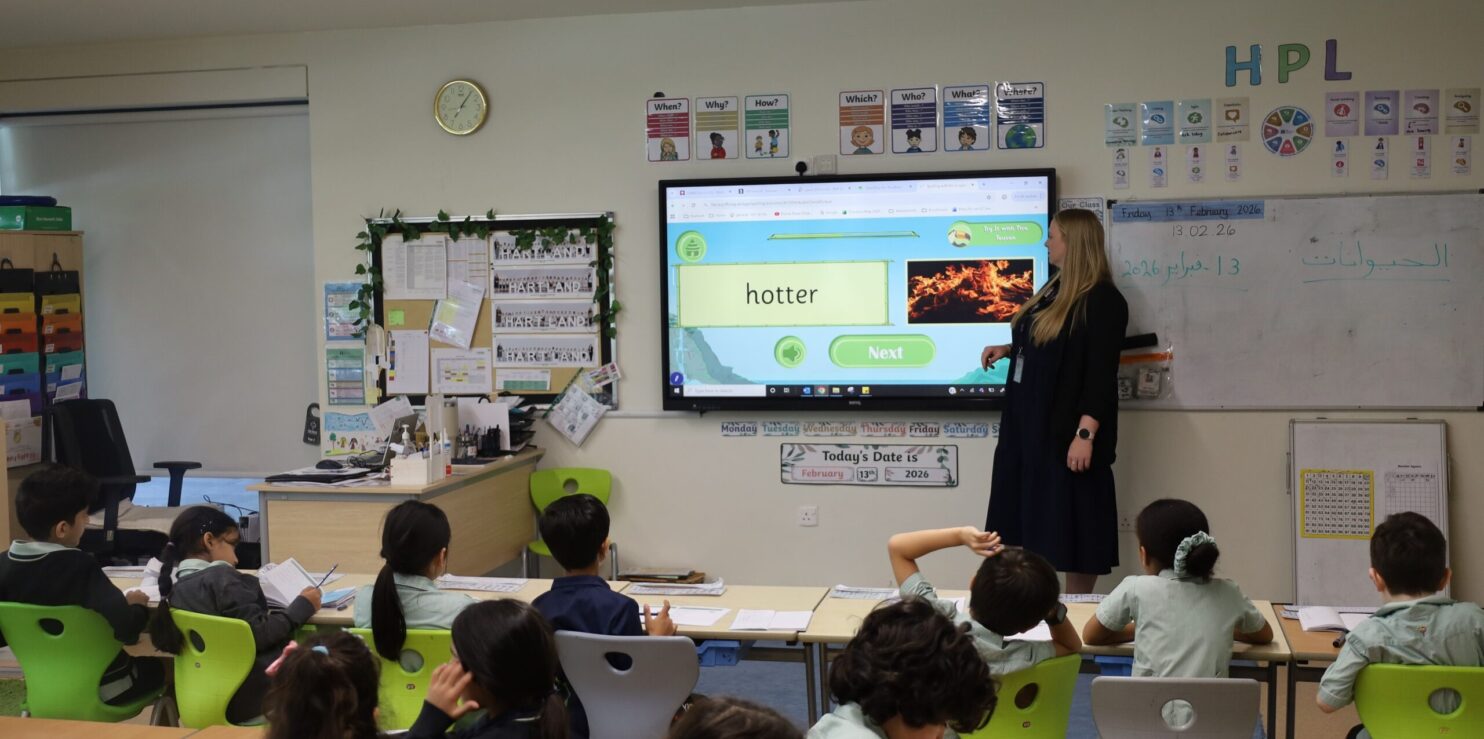
How Hartland International School is building strong reading across 114 nationalities
By FFT Education

Hartland International School is a British international school in Dubai’s Sobha Hartland community, with pupils from 114 nationalities and an eight-form entry in Key Stage 1. Many children are learning to read in English alongside a home language, which is why the school wanted a structured, evidence-based approach to phonics. Here’s what two years of FFT Success for All Phonics has meant for their readers.
Why Hartland chose Success for All Phonics
The school wanted a programme that could flex around a busy staff. Success for All Phonics offered training in several formats — in-person, virtual and pre-recorded — so teachers could build skills at their own pace, backed by FFT classroom observations, data analysis and feedback.
“FFT’s tailored training and ongoing classroom support have empowered our teachers to refine their phonics instruction with confidence and precision.”
— Teachers at Hartland International
Rolling out the programme
Staff worked through the portal’s training modules and videos, then put them into practice through modelling and classroom observation. The phonics lead ran training sessions and worked with the English Language Learners department on the tutoring platform. New adaptive assessments, introduced at the start of the year, gave teachers a more accurate read on where each child was and made target-setting easier across a varied cohort.
Tracking reading progress
The platform’s reports let teachers pinpoint the target sounds each child needs, so teaching can be tailored rather than delivered at one pace. It’s showing in the data: on the most recent Year 2 adaptive assessment, twelve pupils moved from Working Towards the expected standard to Expected over a single half term.
One example is Year 2 Student A, whose reading went from 11 to 50 words per minute in the first half term. Their Fluency Reading Age rose from 4.5 to 6.3, their Decoding Reading Age gained five months, and they finished the most recent assessment inside the time limit with 96% accuracy.
“I understand phonics and like going through the jungle animals. I like the workbook and the ‘congratulations!’ at the end of each day.”
— Student A, Year 2
Supporting multilingual learners
With 114 nationalities on roll, teaching English phonics well alongside other languages is a real challenge. The school leans on the programme’s systematic core — phonemic awareness, decoding and fluency transfer across languages — plus Reading Assessment Programme data to adjust instruction. In practice that means small groups for targeted ELL and EAL pupils, sound mats as visual aids, and the Lightning Squad tutoring platform in Key Stage 2.
Why Hartland recommends it
Phonics Lead Miss Rachel Barron points to the data tracking that lets the school compare year-group and class progress quickly, reliable reading ages for fluency and decoding, heatmaps that flag each child’s target sounds, appropriately pitched adaptive assessments, and training videos that keep implementation consistent across the school.
Find out more – read the full Hartland International School case study or learn more about Success for All Phonics.